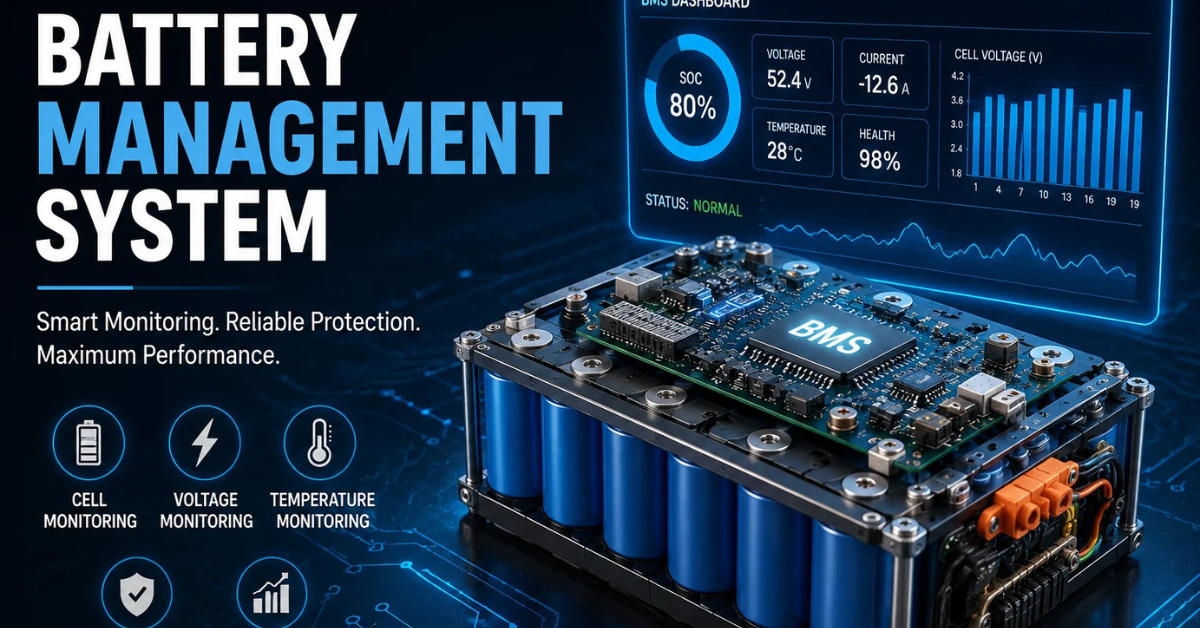
Approximately 70% of battery failures can be attributed to poor charging and discharging practices, underscoring the importance of a well-designed battery management system (BMS). The integration of BMS into devices has become a critical factor in enhancing the overall efficiency, reliability, and safety of battery-powered systems. With the global battery management system market expected to grow significantly, the demand for efficient and reliable battery management solutions has never been higher. As technology advances, the role of BMS in various applications, from electric vehicles to renewable energy systems, will continue to expand.
A Closer Look at Battery Management Systems
A battery management system is an electronic system that monitors and controls the charging and discharging of batteries to ensure their optimal performance, prolong their lifespan, and prevent any potential dangers such as overcharging or overheating. It plays a central role in managing the health of the battery, providing real-time monitoring of battery state parameters such as state of charge (SOC), state of health (SOH), and state of function (SOF). By regulating the flow of electrical current to and from the battery, a BMS helps maintain the battery within a safe operating range, which is vital for preventing damage and ensuring the longevity of the battery.
Leading Battery Management Solutions
1. Modular Battery Management Systems
Modular battery management systems are designed to offer flexibility and scalability, making them suitable for a wide range of applications. These systems are composed of multiple modules, each capable of managing a subset of the battery cells, allowing for the management of large battery packs with ease.
- Why It Works:
- Highly scalable and can be easily expanded or contracted based on the application requirements.
- Provides precise control over each cell or module, enhancing overall efficiency and safety.
- Offers redundancy, which can improve system reliability by allowing the system to continue operating even if one module fails.
- Challenges:
- Higher complexity compared to non-modular systems can increase the cost and require more sophisticated control logic.
- May require more space due to the modular design, which could be a constraint in compact systems.
2. Centralized Battery Management Systems
Centralized battery management systems use a single controller to manage the entire battery pack. This approach simplifies the system design and can reduce costs, making it an attractive option for many applications.
- Why It Works:
- Simpler design compared to modular systems, potentially reducing production and maintenance costs.
- Easier to implement and manage, as all control functions are centralized in one unit.
- Less complex wiring, which can reduce the risk of electrical faults.
- Challenges:
- Lack of redundancy; if the central controller fails, the entire system is affected.
- May not be as scalable as modular systems, limiting its application in large or complex battery systems.
| System Type | Scalability | Complexity | Redundancy |
|---|---|---|---|
| Modular | High | High | Yes |
| Centralized | Low | Low | No |
Practical Takeaways
✔ Optimize Battery Performance
By implementing an appropriate BMS, users can ensure that their batteries operate within optimal parameters, enhancing performance and extending lifespan.
✔ Ensure Safety
A well-designed BMS is crucial for preventing overheating, overcharging, and other conditions that can lead to battery failure or even fires, thereby ensuring the safety of the device and its users.
✔ Monitor Health
Real-time monitoring of battery health allows for predictive maintenance, reducing downtime and extending the overall lifespan of the battery.
✔ Adapt to Applications
Different applications require different types of BMS. Understanding the specific needs of the application is key to selecting the most appropriate battery management solution.
✔ Consider Scalability
Especially in large or complex systems, the scalability of the BMS can significantly impact the system’s overall efficiency and cost-effectiveness.
✔ Evaluate Cost vs. Benefit
The cost of implementing a BMS must be weighed against the benefits it provides, including extended battery life, improved safety, and enhanced performance.
What to Expect Next
- Advancements in BMS technology will lead to more efficient, compact, and cost-effective solutions.
- Increased adoption of electric vehicles and renewable energy systems will drive demand for sophisticated BMS.
- Integration of artificial intelligence and machine learning into BMS for predictive analytics and autonomous decision-making.
- Enhanced focus on battery recycling and sustainable practices, potentially influenced by BMS data on battery health and lifespan.
- Standardization of BMS technologies to facilitate interoperability and compatibility across different devices and systems.
- Growing importance of cybersecurity in BMS to protect against potential vulnerabilities and threats.
Worth Remembering
The battery management system is a critical component in the efficient, safe, and reliable operation of battery-powered devices. Its role will continue to evolve with technological advancements, playing a pivotal part in the transition to more sustainable and renewable energy solutions. Understanding the intricacies of BMS and staying informed about the latest developments is essential for anyone involved in the development, implementation, or use of battery management systems.