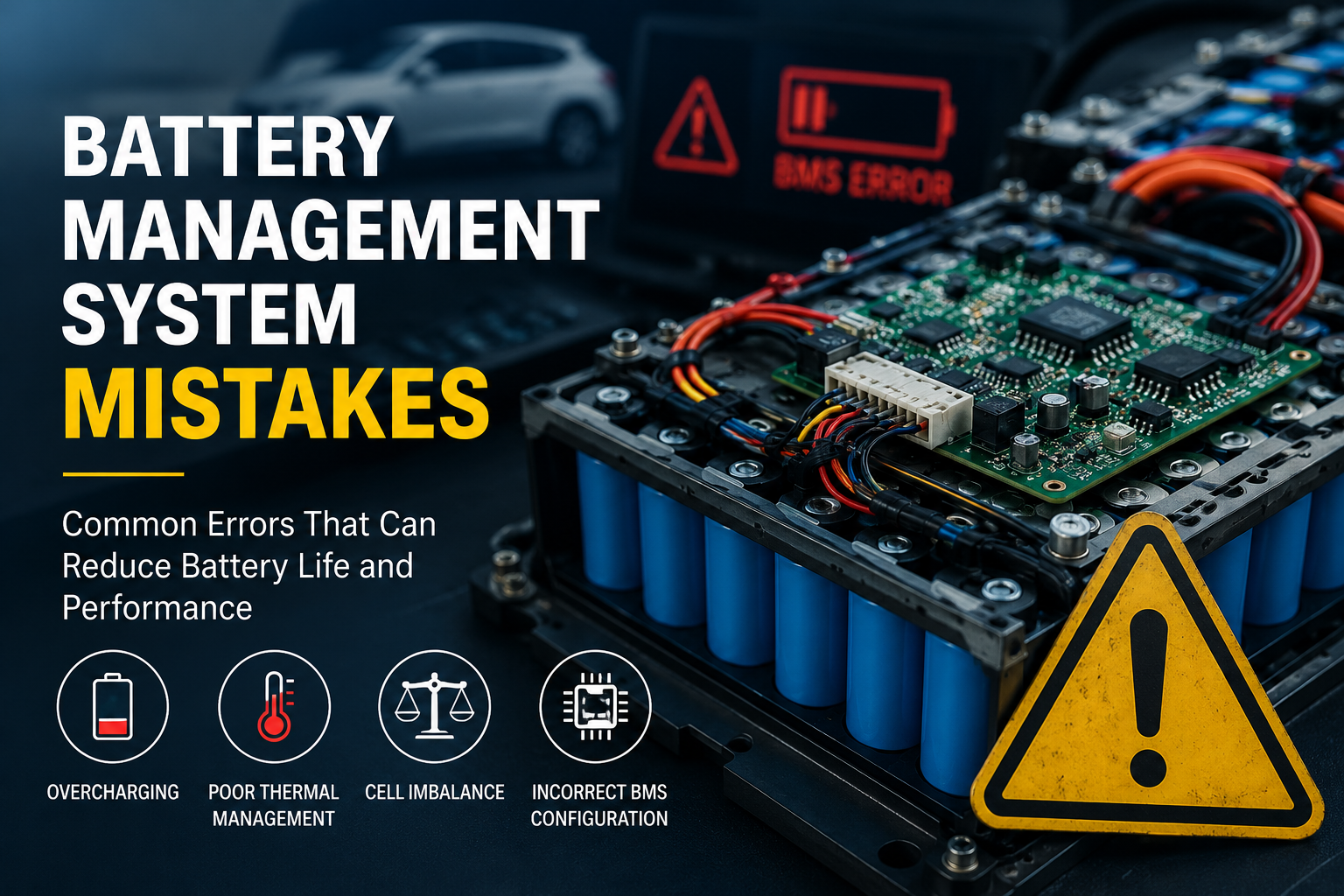
Imagine being on a road trip, only to have your electric vehicle’s battery drain unexpectedly, leaving you stranded. This scenario can be avoided with a well-functioning battery management system. A battery management system is essential for optimizing battery performance and lifespan. However, common mistakes in the design and implementation of these systems can lead to reduced efficiency and lifespan. Understanding these mistakes is crucial for avoiding them and ensuring optimal battery performance.
What Does Battery Management System Mean?
A battery management system (BMS) is a system that manages and controls the charging and discharging of batteries in electric vehicles, renewable energy systems, and other applications. It plays a critical role in ensuring the safety, efficiency, and reliability of the battery. A BMS typically consists of hardware and software components that monitor the battery’s state of charge, voltage, current, and temperature, and adjust the charging and discharging parameters accordingly.
Latest Battery Management System Technologies
1. Advanced Charging Algorithms
Advanced charging algorithms are a crucial component of modern battery management systems. These algorithms use complex mathematical models to optimize the charging process, taking into account factors such as the battery’s state of charge, temperature, and age. This approach helps to reduce charging time, increase efficiency, and prolong the battery’s lifespan.
- Why It Works:
- Optimizes charging process for maximum efficiency
- Reduces charging time and increases battery lifespan
- Improves overall system reliability and safety
- Known Issues:
- Complexity of algorithm development and implementation
- Requires significant computational resources and data storage
- May require additional hardware and software components
2. Battery Monitoring Systems
Battery monitoring systems are designed to track the battery’s state of charge, voltage, current, and temperature in real-time. This data is used to adjust the charging and discharging parameters, ensuring optimal battery performance and safety. Battery monitoring systems can be implemented using a variety of technologies, including voltage and current sensors, temperature sensors, and data acquisition systems.
- Why It Works:
- Provides real-time data on battery performance and health
- Enables optimal charging and discharging parameters
- Improves overall system reliability and safety
- Known Issues:
- Requires accurate and reliable sensor data
- May be affected by noise and interference
- Requires significant computational resources and data storage
| Technology | Description | Benefits |
|---|---|---|
| Advanced Charging Algorithms | Optimizes charging process for maximum efficiency | Reduces charging time, increases efficiency, and prolongs battery lifespan |
| Battery Monitoring Systems | Tracks battery state of charge, voltage, current, and temperature in real-time | Provides real-time data, enables optimal charging and discharging parameters, and improves overall system reliability and safety |
Why This Matters to You
✔ Improved Battery Lifespan
A well-designed battery management system can help prolong the battery’s lifespan, reducing the need for frequent replacements and minimizing maintenance costs. This is particularly important for electric vehicles, where battery replacement can be a significant expense.
✔ Increased Efficiency
A battery management system can optimize the charging and discharging process, reducing energy losses and improving overall system efficiency. This can lead to significant cost savings, particularly in applications where energy consumption is high.
✔ Enhanced Safety
A battery management system can help prevent overcharging, overheating, and other safety hazards that can cause damage to the battery or other system components. This is particularly important in applications where safety is a top priority, such as electric vehicles and renewable energy systems.
✔ Better Performance
A well-designed battery management system can help optimize battery performance, providing faster charging and discharging times, and improving overall system reliability. This is particularly important in applications where high-performance is critical, such as electric vehicles and industrial power systems.
✔ Reduced Maintenance Costs
A battery management system can help reduce maintenance costs by providing real-time data on battery performance and health, enabling predictive maintenance and minimizing downtime. This is particularly important in applications where maintenance costs can be significant, such as industrial power systems and renewable energy systems.
✔ Increased Flexibility
A battery management system can provide increased flexibility, enabling the use of different battery types and chemistries, and supporting a wide range of applications and use cases. This is particularly important in applications where flexibility is critical, such as electric vehicles and renewable energy systems.
How This Will Evolve
- Advances in battery technology will lead to more efficient and cost-effective battery management systems
- Increased adoption of electric vehicles and renewable energy systems will drive demand for advanced battery management systems
- Development of new battery chemistries and technologies will require more sophisticated battery management systems
- Integration of battery management systems with other system components, such as power electronics and control systems, will become more prevalent
- Use of artificial intelligence and machine learning algorithms will become more widespread in battery management systems
- Development of more efficient and cost-effective battery monitoring systems will become a key area of focus
The Bottom Line
A battery management system is a critical component of any battery-powered system, and its design and implementation can have a significant impact on system performance, efficiency, and safety. By understanding the common mistakes in battery management system design and implementation, and by leveraging the latest technologies and techniques, it is possible to create more efficient, reliable, and cost-effective battery management systems. This, in turn, can help drive the adoption of electric vehicles, renewable energy systems, and other battery-powered applications, and can play a critical role in reducing our reliance on fossil fuels and mitigating the impacts of climate change.