As the global shift toward electric mobility accelerates, the year 2025 marks a significant milestone for electric vehicle (EV) innovation—particularly in the field of battery technology. Advances in energy density, charging speed, material science, and recycling are transforming how EVs perform, last, and impact the environment. In this comprehensive analysis, we explore the latest EV battery technologies of 2026, the leading innovators, cost trends, and the future landscape of sustainable energy storage. EV battery technology is what makes electric cars run without petrol.
Understanding the Core of EV Battery Technology
EV batteries are the heart of electric vehicles. They determine how far a car can travel, how fast it can charge, and how long it will last. The performance, safety, and sustainability of EVs are directly tied to battery innovation.
In 2025, EV manufacturers and battery researchers are focused on three main goals:
-
Increasing energy density – to achieve longer range per charge.
-
Reducing charging time – to make EVs as convenient as refuelling.
-
Improving sustainability – through recyclable materials and reduced dependency on rare minerals.
Solid-State Batteries: The Breakthrough of 2026
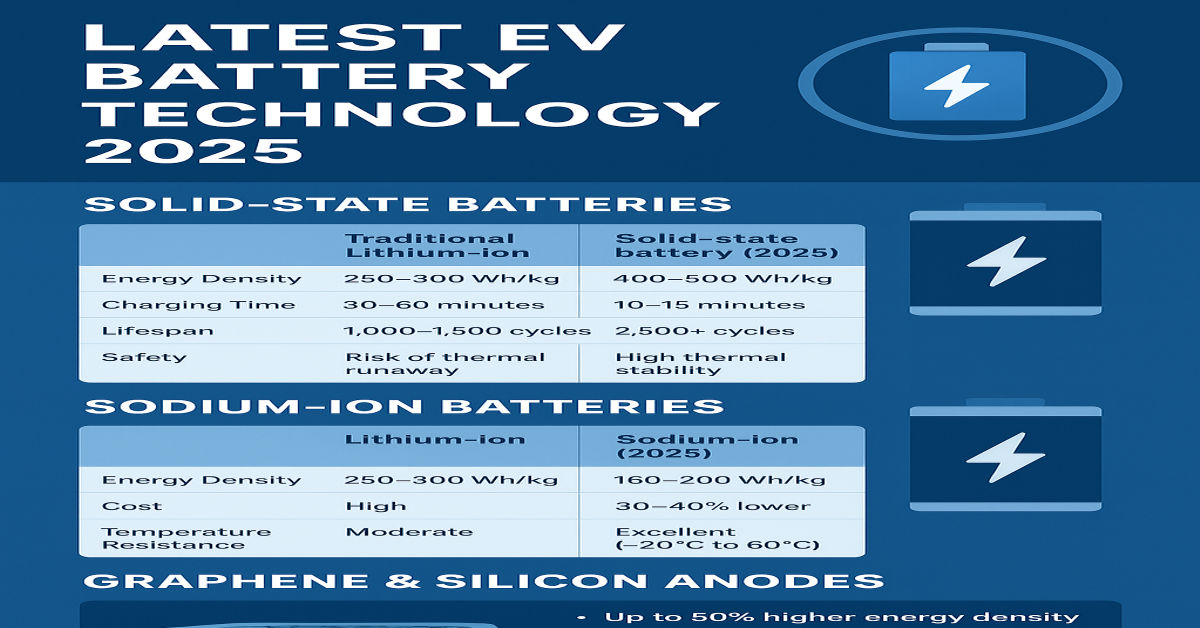
One of the most talked-about breakthroughs in 2025 is the commercialization of solid-state batteries (SSBs). These batteries replace the liquid electrolyte found in lithium-ion batteries with a solid electrolyte, providing several key benefits:
| Feature | Traditional Lithium-Ion | Solid-State Battery (2026) |
|---|---|---|
| Energy Density | 250–300 Wh/kg | 400–500 Wh/kg |
| Charging Time | 30–60 minutes | 10–15 minutes |
| Lifespan | 1,000–1,500 cycles | 2,500+ cycles |
| Safety | Risk of thermal runaway | High thermal stability |
Why it matters: Solid-state batteries promise to double the driving range and drastically reduce charging times. Toyota, QuantumScape, and Samsung SDI are among the pioneers that have introduced early solid-state EV models in 2026.
Toyota’s prototype vehicles now achieve over 700 miles (1,120 km) per charge, reshaping consumer expectations. However, challenges such as production cost and scalability remain the final barriers to full adoption.
Lithium-Iron-Phosphate (LFP) Batteries: The Affordable Choice
While solid-state grabs headlines, LFP batteries continue to dominate the mass-market EV segment. These batteries, known for safety and durability, use iron and phosphate instead of expensive nickel and cobalt. Modern ev battery technology uses lithium-ion cells for better performance.
Advantages of LFP in 2026
-
Lower cost: Up to 30% cheaper than NMC (Nickel-Manganese-Cobalt) cells.
-
Long cycle life: Over 3,000 charge cycles.
-
Enhanced thermal stability: Reduced fire risk.
-
Wider adoption: Used in Tesla Model 3 (Standard Range), BYD, and several European fleet EVs.
Manufacturers like CATL and BYD have refined LFP chemistry to improve low-temperature performance—historically a weak point. In 2025, new LFP versions integrate manganese doping, boosting energy density close to that of nickel-based batteries.
Sodium-Ion Batteries: The Rising Alternative
Sodium-ion technology has gained enormous attention in 2025 as a sustainable and low-cost alternative to lithium-based systems. Sodium, being abundant and inexpensive, offers strategic independence from lithium supply constraints. EV battery technology keeps getting safer with smart cooling systems. Solid-state ev battery technology is coming soon and it’s a game-changer.
Key Highlights:
-
Raw material abundance: Sodium is 1,000x more abundant than lithium.
-
Lower environmental impact.
-
Suitable for short-range EVs and energy storage systems.
| Aspect | Lithium-Ion | Sodium-Ion (2025) |
|---|---|---|
| Energy Density | 250–300 Wh/kg | 160–200 Wh/kg |
| Cost | High | 30–40% lower |
| Temperature Resistance | Moderate | Excellent (–20°C to 60°C) |
CATL and Northvolt have unveiled first-generation sodium-ion battery packs capable of delivering 250 miles per charge, ideal for city EVs and micro-mobility fleets. These are also gaining traction for stationary grid storage, supporting renewable energy integration.
Cobalt-Free and Manganese-Rich Chemistries
In response to ethical and environmental concerns, battery manufacturers in 2026 are moving toward cobalt-free designs. Cobalt, often mined under poor labour conditions, is being replaced with manganese and iron-based chemistries.
Tesla, LG Energy Solution, and Panasonic have all launched cobalt-free variants of lithium-ion batteries. These new chemistries not only reduce dependency on conflict minerals but also improve sustainability and recyclability.
Graphene and Silicon Anode Innovations
The anode—the negative electrode in a battery is a key performance factor. Traditional graphite anodes are being replaced by graphene and silicon composites to boost capacity and charge speed.
Silicon Anode Highlights:
-
Up to 50% higher energy density.
-
Faster charging due to increased ion absorption rates.
-
Reduced weight, improving overall vehicle efficiency.
Companies like Sila Nanotechnologies and Amprius have introduced silicon-anode lithium-ion batteries for commercial EV use, enabling cars to travel 30–40% farther on a single charge compared to 2020-era EVs.
Advanced Battery Management Systems (BMS)
Battery hardware alone isn’t enough—software plays an equally crucial role. In 2026, EVs are equipped with AI-powered Battery Management Systems that optimize charging, monitor cell health, and predict maintenance needs.
Key BMS Capabilities:
-
Real-time monitoring of voltage and temperature.
-
AI-driven performance analytics.
-
Predictive maintenance for extended battery life.
-
Over-the-air updates for continuous optimization.
Manufacturers are integrating machine learning algorithms to enhance thermal management, reduce degradation, and prevent overcharging making EVs safer and more efficient. EV battery technology constantly updates through over-the-air software.
Battery Recycling and Second-Life Applications
As millions of EVs reach end-of-life over the next decade, battery recycling has become a core focus in 2025. Circular economy models are reshaping how materials are reused.
Recycling Leaders:
-
Redwood Materials (USA)
-
Li-Cycle (Canada)
-
Ascend Elements (UK)
These companies use hydrometallurgical and direct recycling techniques to recover over 90% of valuable materials such as lithium, nickel, and manganese.
Second-life applications are also booming used EV batteries are being repurposed for solar storage and grid balancing, reducing waste and lowering energy costs.
Ultra-Fast Charging and Wireless Charging Technologies
Consumers in 2026 expect EVs to charge as quickly as smartphones. This demand is driving two parallel innovations: ultra-fast charging (UFC) and wireless charging.
Ultra-Fast Charging (UFC)
-
Uses 800V systems (as in Hyundai Ioniq 6 and Porsche Taycan).
-
Can charge 80% in under 10 minutes.
-
New solid-state compatible chargers operate at 350–500 kW.
Wireless Charging
-
Embedded charging pads in roads and parking lots.
-
Dynamic wireless charging trials in the UK and Sweden.
-
Enables seamless charging during driving or parking.
These advancements eliminate “range anxiety” and make EV ownership more convenient than ever before.
Battery Safety and Thermal Management Improvements
Safety remains a top priority. In 2026, EV batteries incorporate multi-layered protection systems including advanced cooling materials, fire-retardant separators, and pressure-relief vents.
Thermal Innovations:
-
Phase-change materials (PCMs) to absorb excess heat.
-
Liquid cooling with dielectric fluids for even temperature control.
-
AI-controlled venting systems to prevent explosion risk.
These technologies reduce the chance of thermal runaway, ensuring compliance with new international safety standards like UN 38.3 and IEC 62660-3.
EV Battery Cost Trends and Market Outlook (2025–2030)
Battery prices continue to decline due to mass production, innovation, and improved supply chains. According to industry data, battery pack costs have fallen below $90 per kWh in 2025, down from $137 in 2020.
| Year | Average Cost ($/kWh) | Key Driver |
|---|---|---|
| 2020 | 137 | Scale of production |
| 2023 | 110 | LFP chemistry adoption |
| 2025 | 89 | Solid-state commercialization |
| 2030 (Projected) | 60 | Full circular recycling economy |
This cost reduction makes EVs more affordable and competitive with gasoline vehicles, even without subsidies.
Leading EV Battery Manufacturers in 2025
| Company | Headquarters | Key Innovation in 2025 |
|---|---|---|
| CATL | China | Sodium-ion and LFP hybrids |
| Panasonic | Japan | Solid-state R&D and cobalt-free cells |
| LG Energy Solution | South Korea | Manganese-rich NCM chemistry |
| BYD | China | Blade LFP technology |
| Tesla | USA | 4680 cell with high energy density |
| Northvolt | Sweden | Sustainable battery recycling |
| Samsung SDI | South Korea | Graphene-infused solid-state prototypes |
Competition between these companies is fuelling a wave of technological leaps that benefit the entire EV ecosystem.
Government Policies and Research Funding
Global governments in 2026 are investing heavily in battery research and manufacturing capacity.
-
The European Union’s Battery Alliance supports domestic production.
-
The U.S. Department of Energy has launched a Battery Materials Initiative to secure supply chains.
-
The UK’s Faraday Institution focuses on next-generation solid-state cells.
-
China continues to dominate EV battery exports with large-scale giga factories.
These initiatives ensure national energy independence and promote green jobs.
Environmental Impact and Sustainability Goals
Battery innovation in 2026 goes hand in hand with environmental responsibility. The push for net-zero emissions includes ensuring that battery production itself is sustainable.
Sustainability Trends:
-
Use of recycled materials in new cells.
-
Water-based electrode processing.
-
Carbon-neutral giga factories powered by renewable energy.
Companies like Northvolt and Tesla’s Gigafactory Berlin are leading examples of low-emission manufacturing.
The Role of AI and Digital Twins in Battery Research
Artificial Intelligence and digital twin simulation models are revolutionizing how batteries are developed and tested. Instead of years of physical testing, AI predicts material behaviour, aging, and charge cycles in real time.
-
Predictive analytics shortens development time.
-
Virtual testing reduces cost and waste.
-
Optimization algorithms fine-tune energy density and durability.
AI-driven modelling allows for faster innovation and safer, more efficient battery architectures. EV battery technology ensures your battery charges safely overnight at home.
The Future of EV Battery Technology Beyond 2026
The horizon beyond 2025 looks even more promising. Emerging research areas include:
-
Lithium-sulfur batteries – offering up to 600 Wh/kg.
-
Aluminum-air and zinc-air batteries – ultra-lightweight and recyclable.
-
Bio-inspired electrolytes – derived from organic materials.
-
Modular battery swapping networks – improving EV uptime for fleets.
These next-generation technologies could push EV range above 1,000 miles and enable total recyclability within the next decade.
Conclusion
The latest EV battery technology in 2026 represents a monumental leap toward sustainable, efficient, and affordable mobility. With breakthroughs like solid-state batteries, sodium-ion alternatives, and AI-powered management systems, the electric vehicle revolution is reaching new heights. EV battery technology reduces charging time with faster, smarter systems.
As governments, automakers, and researchers collaborate globally, the focus has shifted from mere performance to sustainability, safety, and scalability. Battery innovation not only drives the EV market forward but also shapes the future of renewable energy and climate action. Better ev battery technology means lower costs for electric vehicles.
The road to a fully electric future is no longer a dream it’s a rapidly unfolding reality powered by smarter, safer, and cleaner batteries. EV battery technology includes software that protects against overheating.