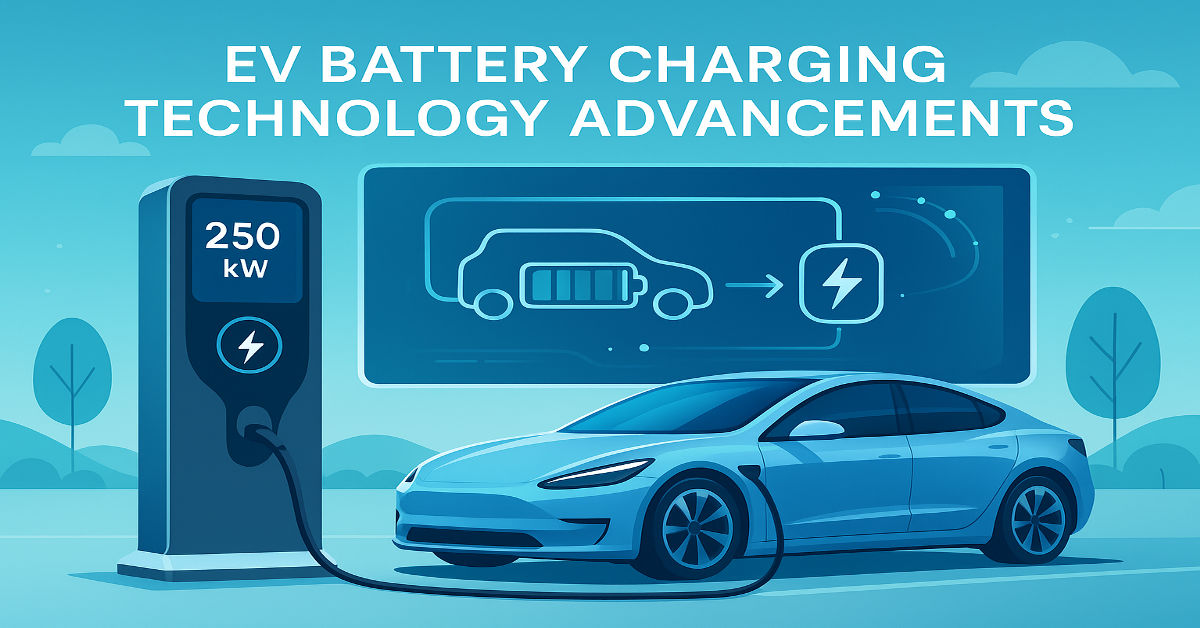
EV Charger Technology Advancements continue to expand across global markets, the single most important innovation shaping their future is EV battery charging technology. Charging has rapidly evolved from slow overnight AC systems to next-generation superchargers, wireless platforms, ultra-fast public networks, bidirectional energy flows, and AI-enhanced smart charging ecosystems.
This article explores all major advancements shaping EV charging today, how they work, why they matter, and what to expect in the next decade.
What Is EV Battery Charging Technology?
EV battery charging technology refers to the methods, hardware, and software systems used to supply electric energy to an EV’s battery. This includes:
-
Charging connectors and standards
-
Onboard and offboard chargers
-
Battery management systems (BMS)
-
Energy storage integration
-
Software, apps, and communication systems
-
Power electronics (inverters, AC/DC converters)
Modern EV charging is not just about plugging in; it involves intelligent communication between the charger, vehicle, grid, and cloud systems to ensure speed, safety, and efficiency.
Why Charging Advancements Matter
The growth of EV adoption depends heavily on improvements in charging technology. Better charging delivers:
-
Reduced range anxiety
-
Shorter charging times
-
Lower energy costs
-
Higher grid efficiency
-
Improved battery lifespan
-
More convenience for EV owners
With the global EV market projected to reach over 200 million vehicles by 2030, advancements in charging are critical to supporting this massive transition.
1. Ultra-Fast DC Charging (High-Power Charging – HPC)
One of the most notable developments is the rise of high-power DC fast charging, also known as HPC (High-Power Charging).
Modern HPC chargers can deliver 150 kW to 350 kW, and future models may exceed 500 kW.
These advancements significantly reduce charging times:
| Charging Technology | Typical Power Output | Approx EV Charging Time (0–80%) |
|---|---|---|
| AC Level 1 | 2–3 kW | 10–20 hours |
| AC Level 2 | 7–22 kW | 4–8 hours |
| DC Fast Charging | 50–150 kW | 30–60 minutes |
| High-Power Charging (HPC) | 250–350+ kW | 15–25 minutes |
| Experimental Ultra-Fast | 500–1000 kW | Under 10 minutes (future) |
HPC improvements include:
-
Thicker, liquid-cooled cables to handle high current
-
Enhanced heat-dissipation systems
-
AI-based power delivery optimization
-
Next-gen silicon carbide (SiC) semiconductor materials
Fast charging is essential for high-traffic corridors, commercial fleets, and long-distance travel.
2. Silicon-Anode Batteries and Faster Charging Capability
Battery innovations are tightly connected with charging advancements. One major improvement is the development of silicon-based anodes, which replace traditional graphite.
Silicon can store 10x more energy, enabling:
-
Higher charging acceptance rates
-
Faster charging with less heat
-
Longer battery range
-
Greater cycle life
Companies like Tesla, Sila Nanotechnologies, and Group14 are leading the silicon revolution. As more EVs include silicon-blend anodes, charging times will continue to shrink.
3. Solid-State Battery Charging Breakthroughs
Solid-state batteries (SSBs) are considered the future of EVs.
Benefits include:
-
Faster charging (under 15 minutes projected)
-
Higher energy density
-
Longer lifespan
-
Improved safety (no liquid electrolyte)
SSB technology allows higher voltages and more stable charging profiles, enabling ultra-fast charging without thermal runaway risks.
Although mass production is still emerging, automakers like Toyota, Nissan, and BMW aim to commercialize solid-state EVs between 2027 and 2030.
4. Wireless EV Charging Systems
Wireless charging, also known as inductive charging, is a revolutionary advancement focusing on convenience.
Aspects of modern wireless EV charging:
-
Uses magnetic coils in the ground
-
EVs charge simply by parking over the pad
-
Delivers 3–20 kW for home systems
-
Public wireless systems reaching 50 kW+
-
No cables, reduced wear, improved safety
A futuristic extension is dynamic wireless charging, where EVs charge while driving over electrified road lanes.
Countries like Sweden, Germany, and the USA are already testing dynamic charging highways.
5. Vehicle-to-Grid (V2G) and Bidirectional Charging
Bidirectional charging enables EVs to act as energy storage units, sending power back to homes or the grid.
Technologies include:
-
V2G (Vehicle-to-Grid)
-
V2H (Vehicle-to-Home)
-
V2B (Vehicle-to-Building)
-
V2L (Vehicle-to-Load)
Benefits:
-
Lower electricity bills
-
Emergency backup power
-
Grid load balancing
-
Renewable energy storage support
For example, a typical 60 kWh EV battery can power a home for 2–3 days.
Bidirectional charging helps stabilize the energy grid, especially during peak demand.
6. Smart Charging and AI-Optimized Charging Networks
Smart charging integrates digital intelligence into the EV ecosystem.
Capabilities include:
-
Real-time price optimisation
-
Automated scheduling
-
Peak-load reduction
-
Battery health monitoring
-
Grid communication through OCPP and ISO 15118
AI-enabled smart chargers can:
-
Predict the best charging times
-
Coordinate fleets automatically
-
Reduce energy costs by up to 40%
-
Extend battery lifespan
These systems are crucial for managing millions of EVs efficiently.
7. Battery Swapping Technology
Battery swapping is a fast-growing alternative to traditional charging. EV drivers can exchange their depleted battery for a fully charged one in under 5 minutes.
Advantages:
-
Zero waiting time
-
Lower upfront EV cost (battery-as-a-service)
-
Ideal for commercial fleets such as taxis, delivery vehicles, and e-scooters
Companies like NIO, Gogoro, and Sun Mobility are pioneering battery swapping.
| Technology | Charging/Swap Time | Best Use Case |
|---|---|---|
| Fast Charging | 15–40 min | Highways, public stations |
| Ultra-Fast Charging | 10–15 min | Long-distance EV travel |
| Battery Swapping | 2–5 min | Commercial fleets, urban mobility |
Battery swapping is expected to grow rapidly in Asia, Europe, and African markets where fleet operations dominate.
8. Next-Generation Charging Standards: CCS, NACS, CHAdeMO, and MCS
Charging standards are evolving to support higher power and wider compatibility.
1. CCS (Combined Charging System)
-
Widely used in Europe and North America
-
Supports 350 kW+ HPC
2. NACS (North American Charging Standard)
-
Tesla-developed
-
Now adopted by Ford, GM, Mercedes, Rivian, and others
-
Increasing global adoption
3. CHAdeMO
-
Early DC fast-charging standard
-
Now less common but still used for V2G technologies
4. MCS (Megawatt Charging System)
Designed for heavy-duty EVs like trucks and buses.
Power output:
1–3 MW, enabling charging times of 20–30 minutes for large vehicles.
This advancement will power electric logistics and long-haul transport.
9. Renewable Energy Integration in EV Charging
Charging networks are increasingly powered by renewable energy.
Renewable integration benefits:
-
Reduced carbon footprint
-
Lower electricity cost
-
More sustainable EV ecosystem
-
Energy independence
Integration methods include:
-
Solar-powered charging stations
-
Wind-powered microgrids
-
On-site energy storage (ESS + batteries)
-
Green hydrogen charging hubs (future)
Some public stations now use solar canopies and battery packs to operate independently from the grid.
10. Charging Robots and Automated Charging
Automation is becoming a major advancement in the charging world.
Technologies include:
-
Robotic charging arms
-
Automated parking + charging
-
Autonomous EV fleet charging hubs
-
Automated battery swap stations
These systems are particularly valuable for:
-
Self-driving cars
-
Large EV fleets
-
Industrial and logistics hubs
Tesla, Hyundai, ROCSYS, and ABB are already testing robotic charging prototypes.
11. Portable and Emergency EV Charging Solutions
Portable charging is a rising technology to eliminate range anxiety.
Examples:
-
Portable battery backup units
-
Towable DC fast chargers
-
Vehicle-mounted charging trucks
-
Mobile “charging-as-a-service” vans
These solutions are especially useful in:
-
Remote locations
-
Emergency roadside assistance
-
Temporary events
As EV density increases, portable charging will become a vital part of the charging ecosystem.
12. Grid-Level Advancements Supporting EV Charging
To support millions of EVs, electricity grids must evolve.
Key grid advancements:
-
Smart transformers
-
AI-driven load distribution
-
Vehicle-to-everything (V2X) communication
-
Microgrid and local generation systems
-
Demand-response programs
-
High-voltage DC infrastructure expansion
These improvements ensure stable, efficient EV charging without stressing national grids.
13. Cooling and Thermal Management Advancements
Fast charging generates significant heat, so advanced cooling technologies are essential.
Modern systems include:
-
Liquid cooling for charging cables
-
Phase-change materials (PCM) in chargers
-
Advanced heat sinks
-
Battery cooling using refrigerants
Improved cooling ensures:
-
Faster and safer charging
-
Longer equipment lifespan
-
Stable operation even at high power levels
14. Cloud-Based Charging Management Platforms
Cloud-connected charging platforms offer:
-
Real-time station monitoring
-
Predictive maintenance
-
Detailed user analytics
-
Remote diagnostics
-
Renewable energy integration control
For EV fleet operators, cloud-based charging reduces downtime and operational costs significantly.
Future Outlook: What’s Next for EV Charging?
The next decade will bring transformative advancements:
1. 1000 kW ultra-fast charging
Charging times may fall to under 5 minutes, resembling a traditional fuel station experience.
2. Wide adoption of solid-state batteries
Safer and faster-charging EVs will become mainstream.
3. Fully automated charging stations
Robotic arms and AI parking assistance.
4. Public wireless charging roads
Enabling EVs to charge continuously while driving.
5. Massive expansion of V2G
EVs will become a core part of national energy grids.
6. Solar-integrated home charging
Smart homes will generate and store EV power intelligently.
Conclusion on EV charger technology Advancements
EV battery charging technology is advancing faster than ever. From ultra-fast DC charging and wireless systems to bidirectional energy flow and AI-enhanced smart networks, the future of EV charging is defined by speed, convenience, sustainability, and intelligence. A wall-mounted ev charger at home cuts charging time in half compared to a standard plug.
As the world transitions to clean transportation, charging innovations will play a central role in determining how quickly societies adopt electric mobility. These advancements not only reduce charging time but also enhance energy efficiency, grid stability, and overall user convenience. An ev charger is like a fancy power socket that safely fills up your electric car’s battery.
EV charging is no longer just a technical necessity it is the backbone of the global electric transportation revolution. Public ev charger stations often have instructions right on the screen no training needed.