Electric vehicles (EVs) have evolved from futuristic concepts to mainstream transportation options across the United States. As more Americans embrace sustainable driving, government incentives have become essential in making EV ownership affordable and practical. While the federal tax credit offers up to $7,500 for qualifying EVs, each U.S. state adds its own incentives, rebates, and benefits to encourage adoption.
This article offers a detailed overview of electric car incentives by state in the USA, explaining how these programs work, what benefits they offer, and which states lead in promoting cleaner transportation.
Understanding Electric Car Incentives
Before diving into state-by-state incentives, it’s important to understand what these programs mean. Electric car incentives are financial or non-financial rewards provided by government or utility companies to encourage consumers to buy or lease electric vehicles.
Incentives can take many forms, such as:
-
Tax credits – Reducing the amount you owe in state income tax.
-
Rebates – Cash returned after purchase or applied instantly at the dealership.
-
Grants – Often for businesses or fleets investing in EVs or charging infrastructure.
-
Reduced registration fees or toll exemptions – Financial perks over time.
-
Home charger rebates – Discounts on EV charging equipment installation.
Each state tailors its program differently, meaning potential savings depend on where you live.
Federal EV Incentive Overview
The U.S. federal government offers a Clean Vehicle Tax Credit of up to $7,500 for qualifying electric and plug-in hybrid vehicles. Eligibility depends on:
-
The vehicle’s final assembly location (must occur in North America).
-
The vehicle’s battery components and mineral sourcing.
-
Manufacturer Suggested Retail Price (MSRP) limits: $55,000 for cars, $80,000 for SUVs, trucks, and vans.
-
Income caps for buyers: $150,000 (single), $300,000 (joint filers).
This incentive works in combination with state programs, allowing buyers to stack benefits for even greater savings.
Why State Incentives Matter
While federal tax credits are substantial, state-level programs fill critical gaps. Some states enhance savings for middle-income families, while others target emissions reduction in specific areas.
State incentives also help:
-
Accelerate charging infrastructure development.
-
Encourage local EV manufacturing and jobs.
-
Reduce pollution and oil dependence.
-
Support rural and low-income households.
Because policies vary widely, consumers must understand their own state’s rules to maximize savings.
Electric Car Incentives by State in the USA (2025)
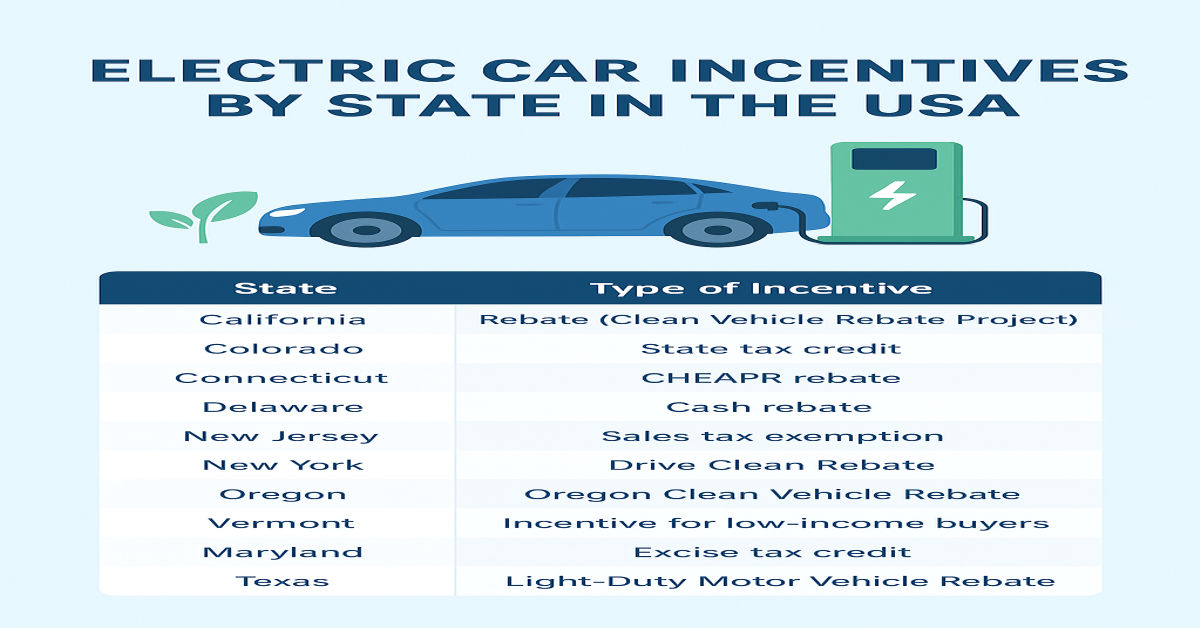
Let’s explore how different states encourage EV ownership. The following table summarizes key incentives offered by selected U.S. states.
| State | Type of Incentive | Approximate Value | Additional Benefits |
|---|---|---|---|
| California | Rebate (Clean Vehicle Rebate Project) | Up to $7,500 | HOV lane access, utility rebates |
| Colorado | State tax credit | Up to $5,000 (2025) | Charger rebate, EV infrastructure support |
| Connecticut | CHEAPR rebate | Up to $4,250 | Used EV incentives |
| Delaware | Cash rebate | Up to $2,500 | Charging rebate via utilities |
| New Jersey | Sales tax exemption | 0% on EVs | Toll discounts |
| New York | Drive Clean Rebate | Up to $2,000 | Utility rebates for charger installation |
| Oregon | Oregon Clean Vehicle Rebate | Up to $5,000 | Charger installation rebates |
| Vermont | Incentive for low-income buyers | Up to $4,000 | Additional used EV rebates |
| Maryland | Excise tax credit | Up to $3,000 | HOV lane access |
| Texas | Light-Duty Motor Vehicle Rebate | Up to $2,500 | Utility rebates for home chargers |
California – The EV Leader
California stands as the most EV-friendly state in the U.S. Through the Clean Vehicle Rebate Project (CVRP), residents can receive up to $7,500 on eligible electric cars. Low-income households may qualify for higher rebates.
California also exempts EVs from smog inspections, provides HOV lane access, and offers utility-based charger rebates. Programs from PG&E, Southern California Edison, and others further support EV adoption.
Colorado – Generous Tax Credits
Colorado’s EV tax credit is one of the best in the country, offering up to $5,000 for new electric vehicles purchased in 2025. Additionally, used EV buyers can claim a smaller tax benefit.
Utility companies such as Xcel Energy provide $500–$1,000 rebates for home charger installation. Combined, these incentives make Colorado an attractive place for EV buyers seeking substantial savings.
Read more:
Connecticut – CHEAPR Program
The Connecticut Hydrogen and Electric Automobile Purchase Rebate (CHEAPR) program gives up to $4,250 toward the purchase or lease of a new EV or plug-in hybrid.
Income-eligible consumers receive additional rebates, and the program now supports used EVs, making sustainable transportation more accessible to all residents.
Delaware – Clean Transportation Incentives
Delaware offers the Clean Vehicle Rebate Program, granting $2,500 for new battery electric vehicles and $1,000 for plug-in hybrids.
State residents can also access utility rebates from companies like Delmarva Power for installing Level 2 home chargers, which can save an additional $500–$700.
New Jersey – Sales Tax Exemption and Rebates
New Jersey is among the few states offering a full sales tax exemption for electric vehicles. This means buyers save 7% instantly at the dealership.
The Charge Up New Jersey program adds up to $4,000 in rebates for eligible EVs, depending on battery range and MSRP. These generous incentives make EVs nearly as affordable as gasoline vehicles.
New York – Drive Clean Rebate
New York’s Drive Clean Rebate provides up to $2,000 off eligible new electric car purchases. Additional local utility rebates (from Con Edison and NYSEG) give up to $500–$1,000 for home charging equipment.
The state’s Zero Emission Vehicle (ZEV) goals aim to phase out gas-powered car sales by 2035, making these incentives key to driving early adoption.
Oregon – Rebates for All Income Levels
Oregon’s Clean Vehicle Rebate Program grants $2,500–$5,000 for new EV purchases. Low- and moderate-income households qualify for higher “Charge Ahead” rebates.
Residents can also claim $600–$1,000 for home charging installations through participating utilities, improving access to convenient charging solutions.
Vermont – Green Incentives for All
Vermont provides some of the nation’s most equitable EV incentives. The Replace Your Ride program offers up to $4,000 for trading older high-emission vehicles for new or used EVs.
Low-income buyers receive higher incentives, and programs often include free public charging credits from local utilities, helping offset ongoing energy costs.
Maryland – Excise Tax Credit and Charger Support
Maryland’s EV program offers an Excise Tax Credit of up to $3,000 for new electric cars. The state also funds rebates for charging stations covering up to 40% of installation costs, capped at $700 for residential customers.
These efforts align with Maryland’s goal to have 300,000 registered EVs by 2030, reducing emissions in urban corridors like Baltimore and Washington suburbs.
Texas – Light-Duty Motor Vehicle Rebate
Texas offers a $2,500 rebate for new electric or hydrogen fuel-cell vehicles through the Light-Duty Motor Vehicle Purchase or Lease Incentive Program.
While smaller than in some states, Texas supplements this with utility-based programs such as Oncor’s EV home charging rebate and discounted time-of-use electricity rates for overnight charging.
Other States Offering Electric Car Incentives
While the ten states above lead in incentives, many others provide smaller but meaningful programs.
| State | Incentive Type | Estimated Value |
|---|---|---|
| Arizona | Utility rebates, charger incentives | Up to $500 |
| Illinois | State rebate program | Up to $4,000 for new EVs |
| Massachusetts | MOR-EV rebate | Up to $3,500 |
| Maine | Efficiency Maine rebate | Up to $2,000 |
| Pennsylvania | Alternative Fuel Vehicle Rebate | Up to $2,000 |
| Washington | Sales tax exemption | 6.5% savings |
| Hawaii | EV infrastructure grant | Up to $5,000 for chargers |
Each of these programs can be stacked with the federal credit, reducing total EV costs by $9,000 to $12,000 in some cases.
Utility and Local EV Incentives
In addition to state-run programs, many utility companies across the U.S. offer rebates for EV purchases or home charger installations. For instance:
-
Duke Energy – Up to $1,000 rebate for installing a home charging station.
-
Pacific Gas & Electric (PG&E) – Discounted electricity rates for EV owners.
-
Southern California Edison (SCE) – Offers rebates for both chargers and used EV purchases.
-
Xcel Energy – Home charger rebates up to $1,200 for Colorado and Minnesota customers.
These localized incentives help reduce ongoing ownership costs and accelerate infrastructure adoption.
The Role of Income-Based Incentives
Several states are implementing income-qualified tiers, ensuring lower-income families also benefit from the EV revolution. For instance:
-
California’s Clean Cars 4 All provides up to $9,500 for scrapping older vehicles.
-
Oregon’s Charge Ahead program offers extra rebates up to $5,000 for moderate-income buyers.
-
Vermont and Massachusetts also provide higher rebates for households below specific income thresholds.
These programs make EV ownership equitable, promoting social and environmental benefits simultaneously.
The Growing Importance of Used EV Incentives
With a growing pre-owned EV market, states are introducing used EV incentives to help buyers access affordable electric options.
-
Colorado: Offers rebates up to $2,500 for used EVs.
-
California: Offers income-qualified rebates up to $4,000 for pre-owned EVs.
-
New York: Some local utilities offer up to $1,000 in used EV purchase rebates.
This trend is expanding access to cleaner transportation for middle-income families.
Environmental and Economic Impacts of EV Incentives
Electric car incentives not only benefit individual buyers but also have broader social and economic effects:
-
Reduced greenhouse gas emissions – EVs cut emissions by up to 70% compared to gasoline cars.
-
Job creation – Incentives encourage automakers to set up EV and battery plants locally.
-
Lower fuel dependency – Reducing reliance on imported oil strengthens national energy security.
-
Public health improvements – Cleaner air quality in urban areas results in fewer respiratory issues.
Each state’s incentive structure plays a direct role in achieving these outcomes.
How to Claim EV Incentives
To make the most of available benefits:
-
Research official state programs – Visit the Department of Energy’s Alternative Fuels Data Center.
-
Check eligibility – Ensure your EV model, price, and income level qualify.
-
Combine programs – Stack state, federal, and utility rebates.
-
Apply early – Some programs have limited funds and expire quickly.
-
Keep documentation – Save proof of purchase, registration, and charger installation receipts.
By following these steps, you can maximize your total EV savings.
Future Outlook: What’s Next for EV Incentives?
The U.S. is moving toward a zero-emission vehicle (ZEV) future, with several states pledging to phase out gas-powered car sales by 2035. Incentives will likely continue evolving to support this transition.
Upcoming trends include:
-
More point-of-sale rebates, eliminating the need to wait for tax season.
-
Expanded used EV and charger rebate programs.
-
Time-of-use electricity pricing to reward smart charging habits.
-
Increased focus on rural and low-income access.
These developments make now one of the best times to invest in an electric car.
Conclusion
Electric car incentives by state in the USA are transforming the automotive market, making EV ownership more affordable than ever. Whether you live in California, Colorado, New Jersey, or Texas, understanding your state’s programs can save you thousands of dollars.
By combining federal tax credits, state rebates, and local utility discounts, you can significantly reduce the cost of purchase, installation, and daily operation.
Electric vehicles aren’t just about sustainability—they represent innovation, economic opportunity, and a cleaner future for all Americans.